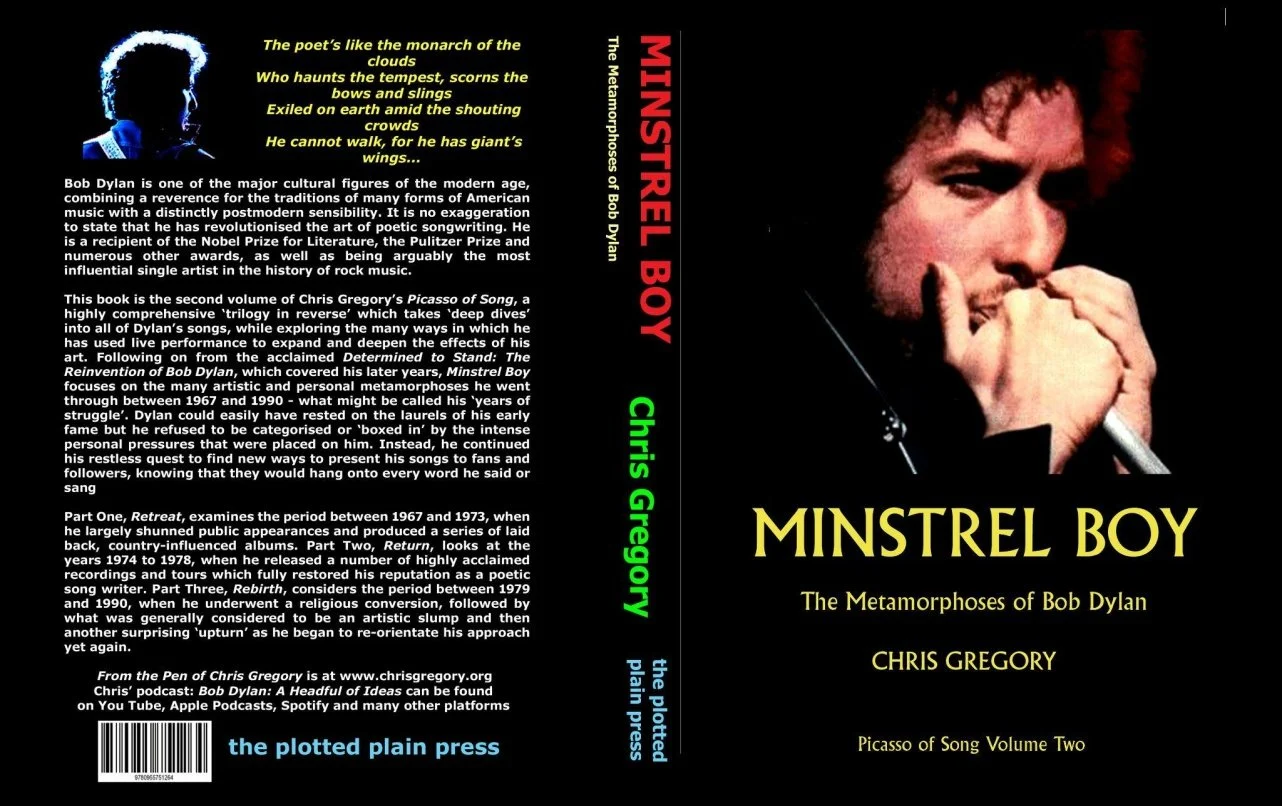
Christopher Gregory’s Minstrel Boy: The Metamorphoses of Bob Dylan (published in October 2025), is our February 2026 book-of-the-month. Minstrel Boy covers Dylan’s “middle period” from 1967 to 1990—23 years and 24 albums. In 2021, Chris released Determined to Stand: the Reinvention of Bob Dylan, a book that threated Dylan’s work from 1990 onwards.
These two books will soon be joined by a third that will cover Dylan’s early work from 1961 to 1967, the three books together forming a series under the title The Picasso of Song. We are accustomed to comparing Bob Dylan to William Shakespeare—but, as Chris has commented, Picasso and Dylan also make a good pair: Picasso being, some would say, the leading artist of the modern art whose his work deals with issues of the modern age and incorporates allusion and revision, much as Dylan’s work does. Leondard Cohen called Dylan the Picasso of song. (See below for an odd digression on Dylan and Picasso that was raised by the biopic A Complete Unknown.)
Gregory has been a prolific contributor to Dylan commentary and scholarship. He has hosted the podcast Bob Dylan” A Head Full of Ideas (the YouTube channel is HERE). He also contiributes articles on is other enthusiasms and is a writer, novelist, and poet. To explore Chris’s work see his website, (chrisgregory.org). His books—as well as downloadable eBook and recorded versions are available via this website. It’s the best way to get buy copies.

Gregory has been generous with his time (including with the Bob Dylan Book Club) and his books, including Minstrel Boy, have recieved lots of attention:
An interview on The Sound Lab
A Review on Indie Boulevard
A Book Review: Chris Gregory “Minstrel Boy – The Metamorphosis Of Bob Dylan – Picasso Of Song, Volume Two” – Americana UK
The Daily Echo
Bilingual Culture Blog
Chris Gregory’s Minstrel Boy treats Dylan’s “middle” period, from 1967 to 1990. A comment on the back flap of the book calls this Dylan’s “years of struggle". He divides the book into three sections: Retreat (when Dylan stepped away from the stage and from the expectations of his fans, Return (when he started performing again and began to search for musical and spiritual direction in his art), and Rebirth (beginning with his “born-again” fundamentalist Christian songs but extending into what Gregory calls a Blakesian approach). These periods treate 24 albums:
RETREAT: 1967-1973 Albums: John Wesley Harding 1967 Basement Tapes 1967-1975 Nashville Skyline 1979 Self Portrait 1970 New Morning 1970 Pat Garrett 1973 Dylan 1973
RETURN: 1974-1978 Albums: Planet Waves 1974 Before the Flood 1974 Blood on the Tracks 1975 Desire 1976 Hard Rain 1976 Street-Legal 1978 Budokan 1978
REBIRTH: 1979-90 Albums: Slow Train 1979 Saved 1980 Shot of Love 1981 Infidels 1983 Real Live 1984 Empire Burlesque 1985 Knocked Out Loaded 1986 Down in the Groove 1988 Oh Mercy 1989 Under the Red Sky 1990
Dylan and Picasso: a digression reposted from our BackPages on the script of A Complete Unknown.
A Complete Unknown and Now, Voyager connect us to Dylan lore about Picasso in three ways: 1. In a Complete Unknown, Dylan diverts Sylvie from their planned trip to see Picasso’s Guernica at the Museum of Modern Art (the mural was moved back to Spain in 1981 after 42 years in New York City, where I myself went to see it!) by saying “Picasso is overrated”. However, in Chronicles Volume One, Dylan praises Picasso, saying that he was a revolutionary and that he (Bob) aspired to write revolutionary songs. There was an artist that Bob felt was overrated—but that was Andy Warhol. Warhol gave Bob a painting (an Elvis portrait) that Bob then traded to Albert Grossman for a couch (the movie is full of composite characters, with rearranged faces and names, so the Picasso for Warhol switch here is not surprising). 2. Rotolo also discovered that Picasso had painted a picture of a French liqueur named Suze (a photo of the bottle is an illustration in Suze's book) which affirmed her attraction to the “Suze” spelling. 3. A third association with Picasso is this: Suze writes in her memoir that she read a book by Picasso’s lover and gained insight into her own plight with Bob—into the difficulties for lovers of great artists. A tear slides down Sylvie’s cheek in the movie theater at the fact that two lovers will lose each other in the end. A major theme of A Complete Unknown is the conflict between Bob’s commitment to music and personal relationships.