
John Wesley Harding is a fascinating and unusual album. Rob Reginio, a professor at Alfred University in western New York State, reminds us of the undercurrents of political and cultural history that influenced the creation of John Wesley Harding. Among other issues, Rob argues that we must understand the album in the context of the Long Hot Summer of urban riots in the US. Ideas of violence and non-violence, and changes in music in general, and Dylan's music in particular are also embedded in this timeline. Just as Blowing in the Wind was a response to its times, so John Wesley Harding is a response to its times, albeit a response that is more penetrating than simple utopian future hinted at by Blowing in the Wind (if we could just grab hold of the answers to the song’s questions).
Reading Reginio’s book inspires a more general observation: a striking characteristic of Dylan’s work is that he consistently links to, and unfolds with, the undercurrents of human and US history. Dylan explores the relation between this history and human nature itself. He searches for the ultimate basis of right and wrong. Songs from throughout Dylan’s catalog could be used as illustrations: It’s Alright, Ma (I’m Only Bleeding)”, My Back Pages, Blind Willie McTell, License to Kill, Murder Most Foul, Tempest, Workingman Blues #2, High Water (For Charlie Patton), Mississippi, Cold Irons Bound, Born in Time, Political World, What Good Am I?, Disease of Conceit…and many more.
How far in and how far down do we fans want to go in following Dylan down this path? In John Wesley Harding’s liner notes we get this exchange between the three visiting kings and Frank:
"Frank," he [the first king] began, "Mr. Dylan has come out with a new record. This record of course features none but his own songs and we understand that you're the key." "That's right," said Frank, "I am." Well then," said the king in a bit of excitement, "could you please open it up for us?" Frank, who all this time had been reclining with his eyes closed, suddenly opened them both up as wide as a tiger. "And just how far would you like to go in?" he asked and the three kings all looked at each other. "Not too far but just far enough so's we can say that we've been there," said the first chief. "All right," said Frank, "I'll see what I can do," and he commenced to doing it.”
Rob Reginio’s advice is to go in further than “not too far”! However, in the Ballad of Frankie Lee and Judas Priest, the little neighbor boy mutters under his breath: “Nothing is revealed”, so we do have to pick our way carefully!
THIS PAGE IS UNDER DEVELOPMENT—CHECK BACK!!! Proceed with caution!

Temporal Gaps Between Dylan Albums
The number of Bob Dylan albums that present a significant number of new original songs by decade, with rounded averaged waiting period from previous album:
1960s 9 albums (9 months)
1970s 7 (18 months)
1980s 7 (15 months)
1990s 2 (4 years)
2000s 3 (3 years)
2010s 1 (3 years)
2020s 1 (8 years)
Running times of Dylan Albums in the late 1960s
Bob Dylan (March 19, 1962): 36:54
The Freewheelin' Bob Dylan (May 27, 1963): 50:04
The Times They Are a-Changin'(February 10,1964): 45:36
Another Side of Bob Dylan (August 8, 1964): 50:37
Bringing It All Back Home (April 1965): 47:21
Highway 61 Revisited (August 30, 1965): 51:26
Blonde on Blonde (June 20, 1966): 72:37
John Wesley Harding (December 27, 1967): 38:24
Nashville Skyline (April 9, 1969): 26:46
A Dylan Time Line, 1965 to 1969
1965
March 22, Bringing It All Home released
August 30, Highway 61 Revisited released
July 25, Dylan goes electric at Newport
August-December, August 30, Forest Hills Tennis Stadium to December 19th, Santa Monica, a total of 38 dates
October 5 and November 30, 1965: studio dates
November 22, married Sara Lownds, and adopts her 4-year old daughter
1966
January 21, 25, February: studio dates
February 4, Tour launches in Louisville, Kentucky
May 27, World Tour ends in London, and Dylan returns home sometime after that; a total of 42 dates over about 3 and a half months, 17 in US, 3 in Canada, 6 in Australia, 16 in Europe
July 20, Blonde on Blonde released
July 29, Motorcycle accident
July 29, 1966, through April 1967, Dylan recovering, no recording sessions, no performances
1967
June-October, Basement Tapes recordings
October-November, John Wesley Harding recording sessions
December 27, John Wesley Harding released
1968
January 20, performs at Woody Guthrie memorial celebration, Carnegie Hall (Guthrie died on October 3, 1967)
1969
February, recording in Nashville
Nashville Skyline released April 9 (a year and 3 months after John Wesley Harding)
May 1, appears on Johnny Cash’s television show
August 15-18, Woodstock Festival (no Dylan appearances, but 8 Dylans songs were performed and one of those (I Shall Be Released) was performed 3 times—by Joan Baez, Joe Cocker, and The Band.
August 31, performs at the Isle of Wight Festival
Digression: American Pie. And now for something completely different. NOT FOR THE FAINT AT HEART!
I know that Don McLean and Bob Dylan both deny what I am about to write—but McLean and Dylan protest too much. McClean’s song American Pie (released July 9, 1999) is an overview of political and music history, including Dylan’s motorcycle accident and John Wesley Harding itself. The song begins with Buddy Holly’s death on February 3rd, 1959 (Holly was 22, Bob was 17), an event that was significant in Dylan’s own musical path and notable because Dylan had been at Buddy Holly’s concert in Duluth three days before the plane crash that killed Holly. As told by Dylan, he had eye contact with Holly in a way that strengthened his feeling of destiny as a musician. Verse 3 refers to Dylan in an earlier and innocent time: “When the jester sang for the king and queen / In a coat he borrowed from James Dean / And a voice that came from you and me”. In Verse 4, the song describes Dylan’s accident and silence during the long wait for John Wesley Harding: “The players tried for a forward pass / With the jester on the sidelines in a cast”. The following lines reference the Rolling Stones appearance at Altamont Speedway in California: “My hands were clenched in fists of rage/ No Angel born in Hell / could break that Satan spell / And as the flames climbed high into the night…” but in those lines and the later lines “And in the streets, the children screamed/ The lovers cried and the poets dreamed” we get a glimpse of the urban riots. Those lines continue with “The church bells all were broken”, hence no Chimes of Freedom, though we could also cite “the cracked bells and washed out horns” from Dylan’s I Want You. We can also interpret “Do you recall what was revealed” and “the courtroom was adjourned” as direct references to John Wesley Harding itself. For those of you who want to stumble down this path:
https://www.youtube.com/watch?v=VsZFiMo8TIc
(this interpretation illustrates the marching band that “refused to yield” in Verse 4 with pictures of the Beatles in Sargeant Pepper attire but to me the marching band was the establishment, the older powers that refused to let younger idealistic folks have power).
Sargeant Pepper’s Lonely Hearts Club Band does enter the conversation in another way: Released on May 26, 1967, the Beatles carried forward the psychodelic effects, multilayered musical arrangements, and the Summer-of-Love version of this time period, a striking contrast to John Wesley Harding, as many have noted.
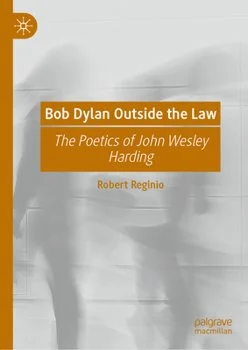
Links about the book Bob Dylan Outside the Law: The Poetics of John Wesley Harding
Erin Callahan's interview of Rob on her podcast Infinity Goes Up On Trial:
infinitygoesupontrial.substack.com/p/of-man-and-god-and-law
The Dylan Review:
thedylanreview.org/2026/02/22/review-of-bob-dylan-outside-the-law-the-poetics-of-john-wesley-harding/
A Trumpet of Sedition:
keith-perspective.blogspot.com/2026/04/bob-dylan-outside-law-poetics-of-john.html
A Personal Memory of a Bob Dylan fan, 1966-1967: Waiting
As I read Bob Dylan Outside the Law, I realized that my own memories of that time—of urban unrest, race riots, assassinations, protests, repression, the Vietnam war, the draft lottery, dropping out, drugs—were dormant, folded up and put away in some forgotten closet. Reginio’s book brought those times back. But as I read I also remembered what it was like to be a Dylan fan in those years and that is what I report here.
I had been a dedicated fan from 1963 onward. Bob Dylan Outside the Law conjures up an amazing part of the Dylan timeline that unfolded from The Freewheelin’ Bob Dylan (1963) to John Wesley Harding (1967)—from Blowin’ in the Wind and Master’s of War to As I Went Out One Morning and All Along the Watchtower, by way of Mr. Tambourine Man, Desolation Row, Newport 1965, and the 1966 World Tour.
1966 and The Conclusion of the “Going Electric” Period
In a clip from Dylan’s 1966 European tour that appears in Martin Scorsese’s No Direction Home, Dylan tries to keep his eyelids from sliding down over his eyes as he says to an Italian tour arranger “I want to go home. You know what home is? I don’t want to go to Italy no more. I don’t want to go nowhere no more. You end up crashing in a private airplane in the mountains of Tennessee” [editor’s note: this line always stood out to me because later, in 1978, I was doing research in the Great Smoky Mountains of Tennessee and several times flew over the mountains in small planes]. The tour arranger then asks, essentially, can Dylan visit Italy the next time he comes to Europe To which Dylan replies]: “I don’t know. I just want to go home.” Dylan was clearly mentally and physically exhausted.
Soon after his last concert date in London on May 27, 1966, Dylan returned to Sara and her daughter Maria who was four and who had been adopted by Dylan soon after the couple married on November 22, 1965. Dylan had reached a kind of crescendo during the 1966 World Tour. The concerts began with a solo acoustic set and, after intermission, a full band of electric guitars, keyboards, and drums. The dates in the United Kingdom (the last 17 shows of the tour) were especially confrontational, featured booing, denouncements, and, on May 17th, the shout of “Judas!” [Editor’s note: I was a high school exchange student in Denmark in 1966 and somehow got permission to travel to Copenhagen for the show on May 1st during which there was no booing. bit rather a feeling of reverent attention.] For more context see Book Club back pages for Dylan Goes Electric!
The Motorcycle Accident
Dylan’s 7th album, Blonde on Blonde, was released on July 20, 1966…and then just 9 days later, on July 29th, came the news, not of a plane crash in Tennessee, but of a motorcycle accident in Woodstock, New York. There were few details! Was Dylan alive? Was he seriously injured? Was it brain damage? Disfigured? Would he ever write songs or go on tour again? Would we have to go without his voice (both literally and in terms of the subjects of his songs)? There were no official or eyewitness descriptions of Dylan’s condition, no official updates, and no news of his treatment or recovery. There was no prediction of when he would return. As Wikipedia reports: No police report filed, no ambulance called, no hospital records.
How serious was Dylan’s accident? For a recent discussion with Laura Tenschert and Rebecca Slaman see Definitely Dylan’s Bob Dylan Hotline #16.
In Chronicles Volume One, Dylan commented “I had been in a motorcycle accident and I’d been hurt but I recovered. Truth was I wanted to get out of the rat race.” And he did: an extensive new tour was cancelled and the production of an ABC TV special and the completion of a novel (See Book Club notes on Tarantula). He was also escaping the pressures of celebrity, as he withdrew from the public eye.
The Long, Long, Long, Long Wait
What I remember most about being a Dylan fan from the summer of 1966 to the winter of 1967 (a year and a half!) was the long, long wait for the next Dylan album. To understand this, you have to remember this: if we ignore the 15 month gap from Dylan’s first album to his second album, the next five Dylan albums, ending with Blonde on Blonde (July 20, 1966), had appeared at an average of 7.5 month intervals, one masterpiece after another. Dylan’s 8th album, John Wesley Harding, was released on December 27, 1967, after a wait of 18 months. Heightening the anxiety, as made clear by Reginio, Dylan’s silence was cast against churning political events. For a decade by decade perspective on the intervals between Dylan albums, see above.
Looking at all of Dylan’s career, long wait times have become the rule (see list above), not the exception, so we old folks aren’t going to get much sympathy. In 1967 we the silence was—deafening and also was a period with no public appearances (see time line below).
What We Got
The long wait was over on December 27th, 1967, when John Wesley Harding was released. As for what the new album would be like, we had little to go on. We didn’t know about the Basement Tapes, though some of us, including me, did buy those white albums—the original Dylan bootlegs. I was in New York City when my roommate returned to say there was a guy on the street selling stolen Dylan albums. I went to investigate and found a young man my age with a trove of white-covered albums in brown paper bags.
In the end, John Wesley Harding was surprising—even shocking—it’s short length, it;s sparse and rural musical style, and it’s archaic sounding vocabulary that contained biblical references.
Length
Part of the pride of being a Dylan fan in the 1960s was album and song length—the knowledge that he would blow past the conventions of popular music and that song length would meet the needs of the song. Long songs were an immersion experience. The three Dylan albums that preceded John Wesley Harding averaged 57 minutes in length and the most recent Dylan album, the double album Blonde on Blonde was 72 minutes long. John Wesley Harding (ay 38 minutes) was almost 20 minutes shorter than the average of the three preceding albums and 34 minutes shorter than Blonde on Blonde. In 1967, John Wesley Harding was Dylan’s second shortest album, just 4 minutes longer than his debut album Bob Dylan.
In terms of the song length, 10 of John Wesley Harding’s 12 songs were in the 2-4 minute range—a far higher percentage than Blonde on Blonde (4 of 12 were in the 2-4 minute range), Highway 61 Revisited (2 of 9 songs), and Bringing It All Back Home (6 of 11 songs).
Musical style
John Wesley Hardin did not sound like any previous Dylan album. The instrumentation was sparse, and the sound was acoustic—a quietness that contrasted so much with the loud competing instruments and dense lyrics of Highway 61 Revisited and Blonde on Blonde. The song structure was simple (there were no bridges, except for I’ll Be Your Baby Tonight, or choruses, unless we include the line “I’ll be your baby tonight” as a chorus because it is repeated at the end of each verse). The sound was rural but not like either the country music that originally inspired Dylan or the commercial country music that was being recorded in the late 1960s. It doesn’t sound like his first album, his folk albums, or, after we finally got to hear them years later, the Basement Tapes. John Wesley Harding was more acoustic and “folky” than country music though the low key drums and steel guitar (on some tracks) are themselves a country reference point and the album was recorded in Nashville, Tennessee. To me it sounds “old timey”, one of the “roots” of country music, vaguely dating to the 1940s and earlier.
“I’ll Be Your Baby Tonight” is the exception—it can be listened to as a bona fide country song and as a precursor of Nashville Skyline (released on April 9, 1969, one year and four months after John Wesley Harding). But as a whole, John Wesley Harding has always seemed to me to be like a cul de sac, having few immediate precedents and few immediate descendants, at least in terms of the 1960s Dylan catalog.
Archaic vocabulary and biblical references
Here are some references, word usages, and images in the songs of John Wesley Harding: All across the telegraph, the fairest damsel, ye gifted kinds and queens, amongst the ones, plowmen, let us not talk falsely now, all along the watchtower princes kept the view, barefoot servants, two riders, the plotted plain, eternity, paradise, the gambler, while the mission bells did toll, carried him to rest, outside the crowd was stirring, everybody knelt to pray, when that steamboat whistle blows, I have tried my hand at bribery, fourteen-karat gold in my mouth, kind ladies and kind gentlemen, wander off in shame, live by no man’s code, he hears but does not see, builds his town with blood, from Eli he did come, his tongue could speak but only flatter, the seas began to part, if ye cannot bring good news…I rest my case.
Wikipedia reports “Bert Cartwirght [incorrectly identified as Bert Carter on some websites] identified over 60 distinct biblical allusions woven throughout the sparse, parable-like tracks.” Cartwright published the revised and expanded edition of his work, The Bible in the Lyrics of Bob Dylan, in 1992. This second edition was published in Wanted Man Study Series. A google search will help you find this and other discussions. I’ll include some of the links in a separate box on this page.